Social Impact Analysis and Modeling Study of Local Humanitarian Forum
Integrity Consulting conducted a comprehensive social impact analysis and modeling study of the Local Humanitarian Forum, examining how local leadership is transforming humanitarian coordination in post-earthquake Türkiye
On February 6, 2023, two devastating earthquakes struck southeastern Türkiye, causing widespread destruction and displacing millions. In the aftermath, local civil society organizations came together to form the Local Humanitarian Forum (LHF)—an unprecedented coordination platform that would become one of the most significant case studies of “localization in action” in recent humanitarian history.
Established as an offshoot of the Localization Advocacy Group (LAG) and operating under Support to Life Association with the Civil Society Development Center (STGM), the LHF was created to strengthen the participation of local and national civil society organizations in the UN-led earthquake coordination system. It rapidly grew into a powerful voice for local actors, organizing face-to-face meetings, online events, trainings, and advocacy campaigns through its network of provincial representatives.
Integrity Consulting was commissioned to conduct a comprehensive social impact analysis and modeling study of the LHF, examining its role, achievements, challenges, and potential as a model for localized humanitarian coordination globally.
The Social Impact Analysis
Integrity Consulting designed and implemented a comprehensive social impact analysis and modeling study to examine the LHF’s contribution to humanitarian coordination transformation. The study assessed how local leadership through the LHF has influenced coordination dynamics, resource allocation, decision-making processes, and the broader localization agenda in Türkiye’s post-earthquake response.
The modeling component of the study examined the LHF’s systemic impact—how a local coordination platform can catalyze wider transformation in the humanitarian ecosystem, challenging traditional top-down coordination structures and creating space for meaningful local participation in humanitarian decision-making.
Webinar: From Crisis to Coordination
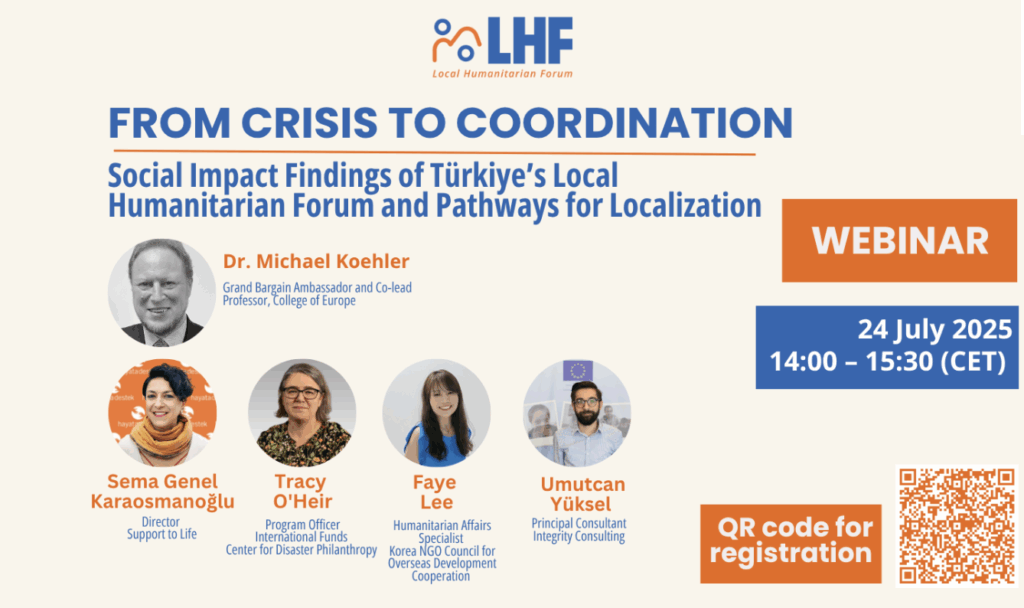
On July 24, 2025, Integrity Consulting co-hosted a bilingual webinar with the LHF to present the findings of the social impact analysis and modeling study. The webinar, titled “From Crisis to Coordination: LHF Social Impact Findings and Localization Roadmap,” brought together distinguished speakers from across the humanitarian sector to discuss global localization efforts, operational challenges, and the role of local coordination platforms in catalyzing system-wide transformation.
Key Findings
The social impact analysis revealed several critical insights about the LHF’s role in reshaping humanitarian coordination in Türkiye:
Safe Space for Local Actors
LHF provided a safe and inclusive space for local organizations to coordinate, share information, and amplify their collective voice within the international humanitarian system.
Increased Visibility
The forum significantly increased the visibility and recognition of local and national organizations within humanitarian coordination structures, enabling them to participate as equal partners.
Innovative Solutions
LHF produced innovative coordination solutions and ensured the effective use of resources, demonstrating that local platforms can drive efficiency in humanitarian response.
Transformative Impact
Structures like LHF challenge existing systems and create transformative impact, demonstrating that transparency, community-based approaches, and local leadership can reshape humanitarian coordination.
Speakers & Key Insights
The webinar brought together leading voices in humanitarian localization, moderated by Asuman Şahin, LHF Coordinator.
Deputy Director-General (ret.), DG ECHO, European Commission
Professor, College of Europe
Localization Roadmap: From Commitment to Action
A central output of the study was a forward-looking localization roadmap that translates the LHF experience into actionable recommendations for the broader humanitarian sector. The roadmap addresses the persistent gap between localization rhetoric and reality.
The roadmap proposes key shifts aligned with the Grand Bargain’s third phase priorities:
From Rhetoric to Structural Change
Moving beyond verbal commitments to localization toward concrete transfers of power, authority, and resources to local actors—including decision-making roles in coordination mechanisms and direct access to funding.
Replicating Local Coordination Platforms
The LHF model demonstrates that local coordination platforms can catalyze system-wide transformation. The roadmap outlines how similar structures can be established in other crisis contexts, adapted to local realities.
Strengthening Local Systems for Sustainability
Investing in the institutional capacity and sustainability of local organizations and coordination platforms—not as one-off projects but as permanent features of the humanitarian architecture.
Bridging the Accountability Gap
Establishing accountability frameworks that are bidirectional—ensuring local actors are accountable to affected communities while international actors are accountable to their localization commitments.
Conclusion
The social impact analysis of the Local Humanitarian Forum provides compelling evidence that localization is not merely a policy aspiration but a practical, achievable model for humanitarian coordination. The LHF’s experience in Türkiye demonstrates that when local actors are given the space, resources, and recognition to lead, humanitarian response becomes more effective, contextually appropriate, and sustainable.
As the humanitarian sector enters the third phase of the Grand Bargain, the findings from this study offer both a mirror and a roadmap: a mirror reflecting how far the system still has to go, and a roadmap showing how platforms like the LHF can lead the way forward.
Integrity Consulting remains committed to advancing evidence-based approaches to humanitarian localization and continues to support local actors in strengthening their role within the global humanitarian architecture.