
Türkiye Floods Update
Persistent heavy rainfall across Türkiye’s Aegean and Mediterranean coasts has killed at least five people, triggered mass evacuations in Antalya, and forced dams to emergency capacity — exposing the compounding risks of climate change, urbanisation, and earthquake-weakened infrastructure.
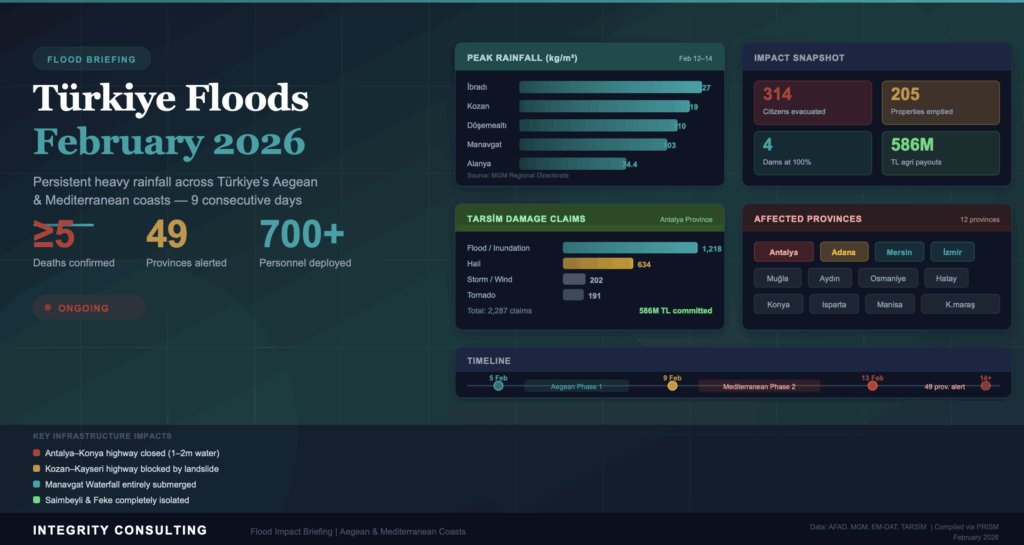
Between 5 and 14 February 2026, successive waves of heavy rainfall swept across Türkiye’s western and southern coasts, triggering flash floods, landslides, and river overflows that killed at least five people, forced the evacuation of hundreds of residents, and shut down critical transport corridors. The Turkish Meteorological Service (MGM) issued yellow-coded alerts for 49 provinces on 13 February — the most extensive severe-weather warning of the year.
The disaster arrived in two distinct phases. The first struck İzmir, Muĝla, and Aydın between 5 and 7 February, claiming five lives in flood-related drownings. The second — far more destructive — escalated across Antalya, Adana, Mersin, and Osmaniye from 9 February onward, pushing dams to 100 percent capacity, submerging the world-famous Manavgat Waterfall, and forcing AFAD rescue teams to conduct boat evacuations in Alanya where water reached chest height inside residential buildings.
This briefing draws on MGM meteorological data, AFAD emergency reports, EM-DAT historical disaster records, INFORM Risk Index data, and Turkish media reporting to map the intersection of climate hazards, urbanisation pressures, and infrastructure vulnerability that defines Türkiye’s flood risk landscape.
February 2026 Emergency
The first wave of flooding struck Türkiye’s Aegean coast between 5 and 7 February, affecting İzmir, Muĝla, Aydın, and Uşak provinces. Floodwaters claimed five lives across İzmir and Muĝla — including fatalities in flooded underpasses, vehicles swept off bridges, and people carried away by overflowing streams. The affected districts included Torbalı, Menderes, and Marmaris. AFAD, Jandarma, and underwater rescue teams were deployed across multiple recovery operations.
İzmir Province — Rainfall Recorded
5–6 February 2026 · MGM Station Measurements
Source: MGM & İzmir Metropolitan Municipality, February 2026
Beyond the fatalities, the Aegean floods caused widespread material damage. İzmir’s fire department received over 175 emergency flood calls. In Seferihisar, the neighbourhoods of Payamlı, Ürkmez, and Cumhuriyet experienced severe water intrusion. In Uşak, 35 businesses — workshops, depots, and factories — flooded after the Çanlı Stream overflowed. Ferry services between Bodrum and Datça were cancelled as winds reached 80 km/h.
Antalya: The Epicentre
From 9 February onward, the centre of gravity shifted decisively to Türkiye’s Mediterranean coast. Antalya Province bore the brunt, with the MGM issuing warnings of 50–100 kg/m² rainfall and storm-force winds of 50–90 km/h. On 13 February — described by local media as one of the worst days in the city’s modern history — cascading failures overwhelmed infrastructure across multiple districts.
In Manavgat, the Oymapinar, Naras, and Manavgat dams all reached 100 percent capacity, forcing the State Hydraulic Works (DSİ) to open emergency sluice gates. The resulting surge pushed river levels beyond control: the world-famous Manavgat Waterfall was entirely submerged, with surrounding restaurants, picnic areas, and tourist walkways transformed into a vast lake.
The Antalya–Konya highway — a critical commercial and tourism transport artery — was closed in both directions at the Demirkapı Tunnel exit after floodwaters reached 1 to 2 metres on the road surface. Authorities warned the closure could last approximately one week. When drivers attempted the alternative route via Madenli–Süleymaniye (Seydişehir), a landslide emerged due to saturated soil, putting the secondary corridor at risk as well.
Antalya Province — Rainfall Recorded
12–14 February 2026 · MGM Station Measurements (kg/m²)
Source: MGM Regional Directorate 4, February 2026 · Antalya Governorate (AA)
The most acute crisis unfolded in Alanya on 14 February. After three consecutive days of rain — with 74.4 kg/m² falling in the final 24 hours alone (Antalya Governorate / MGM) — the Dim Dam reached full capacity and DSİ began controlled water release. The Dim and Oba Rivers overflowed, inundating residential areas, businesses, and agricultural land. In Kestel Neighbourhood, water rose to chest height inside ground-floor apartments, prompting AFAD teams to deploy boats for residential rescues.
The Alanya District Governorship activated a full-scale evacuation in Tosmur and Kestel Neighbourhoods. Separately, in Küçükhasbahçe Neighbourhood, a topsoil collapse triggered landslide risk that forced the precautionary evacuation of 7 residential buildings. A geotechnical assessment is ongoing.
314 Citizens Evacuated
The Alanya District Governorship evacuated 314 residents from Tosmur and Kestel, with 48 placed in public guesthouses.
205 Properties Emptied
132 homes and 73 businesses were formally emptied after receiving evacuation notices across Alanya.
501 Personnel Deployed
137 response teams with 501 personnel and 181 vehicles were mobilised for flood and rescue operations.
4 Dams at 100% Capacity
Oymapinar, Manavgat, Naras, and Dim dams all reached full capacity, triggering emergency water releases.
Schools were closed across 7 Antalya districts (Alanya, Gazipaşa, Kumluca, Kaş, Demre, Finike, Kemer) and 6 Mersin districts (Mut, Bozyazı, Gülnar, Erdemli, Silifke, Aydıncık). Meanwhile, Adana Province experienced a parallel crisis of its own, detailed in the following section.
Adana: Isolation & Infrastructure Collapse
While Antalya dominated media coverage, Adana Province experienced a parallel crisis across its northern highland districts. Two consecutive days of heavy rainfall — with MGM recording 119 kg/m² in Kozan district alone — overwhelmed river systems and severed critical transport links, effectively isolating entire communities from the provincial centre.
The worst-hit district was Kozan, where overnight flooding on 13–14 February caused damage visible from the air by daybreak. The Göksu River — a major tributary of the Ceyhan — overflowed its banks after the riverbed exceeded capacity, inundating farmland, residential courtyards, and the Dilekkaya Neighbourhood surrounding the Anavarza Ancient City — a site on the UNESCO World Tentative Heritage List. Local residents noted that a similar flood struck the area in 2019, when helicopter and boat deliveries were required to supply isolated villagers. The State Hydraulic Works (DSİ), Kozan Municipality, and the Ceyhan Irrigation Union worked to build emergency embankments and redirect water flow away from the archaeological zone and residential areas.
In Kozan town centre, the Küçük Sanayi Sitesi (Small Industrial Zone) was submerged, flooding workshops and leaving tradespeople unable to operate. In Bucak, citrus orchards were destroyed, while homes in Akköprü were buried in mud. The Kozan–Kayseri highway was completely closed after the Göksu River’s overflow triggered a landslide that collapsed the road surface. The metropolitan slaughterhouse was also submerged, disrupting local meat supply chains across the province.
119 kg/m² Rainfall
MGM recorded 119 kg/m² in Kozan — among the highest readings anywhere in the flood zone outside Alanya.
UNESCO Heritage at Risk
Anavarza Ancient City and surrounding farmland in Dilekkaya submerged after the Göksu River overflowed.
2 Districts Isolated
Saimbeyli and Feke were cut off from the provincial centre after road collapses and rockfall severed all access routes.
240 Response Personnel
Ceyhan Municipality alone deployed 40 vehicles and 200 personnel overnight; Kozan and Adana Metropolitan teams joined the effort.
To the north, the crisis was even more severe. In Saimbeyli, the Göksu River far exceeded its capacity, flooding the Yeşilvadi area and destroying the road surface. District Governor Emre Aydın and Mayor Mahmut Dal jointly ordered the closure of all district entry and exit points on safety grounds, and at least one neighbourhood was fully evacuated. The Feke–Saimbeyli road was closed in both directions by Jandarma and the Highways Authority after the road collapsed under floodwater. Mayor Dal described the situation as reaching disaster proportions, with the Delicay river also surging beyond control.
In neighbouring Feke, floodwaters cut off four villages — Gedikli, Kisenit, Gürümze, and Bahçecik — from the town centre, isolating residents from municipal water, sanitation, and health services. In Ceyhan, the district municipality mobilised 40 vehicles and 200 personnel overnight on 13 February to address flooding, fallen trees, blocked drains, and road obstructions across both urban and rural areas, coordinating with Adana Metropolitan Municipality units.
The Adana floods underscore a recurring pattern: the province’s mountainous northern districts — Kozan, Saimbeyli, Feke, and Tufanbeyli — sit along narrow river valleys where even moderate rainfall can trigger rapid, destructive flash floods. Unlike the Mediterranean coast, these communities lack the infrastructure redundancy to absorb road closures: when a single highway collapses, an entire district can be rendered unreachable.
Climate & Disaster History
Türkiye’s flood history reveals an alarming pattern of escalating severity. The EM-DAT International Disaster Database documents approximately 950 flood-related deaths between 1960 and 2023, with cumulative economic losses exceeding $2.5 billion from 1948 to 2020. The frequency and intensity of extreme precipitation events has increased markedly in recent decades, driven by the interplay of climate change, unplanned urbanisation, and construction on flood plains.
MAJOR FLOOD EVENTS IN TÜRKİYE
Confirmed deaths · Selected events 2009–2026
The August 2021 Western Black Sea floods remain the benchmark: 97 killed, 228 injured, over 1,800 evacuated, and at least 454 buildings significantly damaged across Kastamonu, Sinop, and Bartın provinces. Water rose to 4 metres in Bozkurt. The March 2023 floods in Şanlıurfa and Adıyaman — striking just one month after the devastating 6 February earthquake — killed 21 people and swept away container homes sheltering earthquake survivors.
The February 2026 event, while smaller in death toll thus far, is notable for its geographic breadth, the cascading infrastructure failures (four dams at capacity, multiple highways closed), and the prolonged duration — continuous heavy rainfall across nine consecutive days with no recovery window between phases.
Risk Assessment
Türkiye occupies a unique position in the global risk landscape. The INFORM Risk Index classifies the country in the Medium risk category (approximately 4.0–4.5), but this aggregate score masks exceptionally high natural hazard exposure. Türkiye faces a convergence of seismic, flood, and drought hazards at levels matched by few other countries.
The World Risk Report 2025, which focuses specifically on floods, highlights Türkiye’s dual climate threat: the country is projected to be among the most drought-prone nations globally, while simultaneously experiencing more frequent and intense precipitation events. This paradox — drought in the interior and flooding on the coasts — mirrors the pattern observed across the broader Eastern Mediterranean.
The February 2026 event illustrates this risk profile in action. Temperatures were running above seasonal norms, contributing to intense evaporation from a warm Mediterranean Sea and feeding powerful low-pressure systems that swept moisture-laden air onto the coast. The MGM explicitly warned of flash flood, landslide, and avalanche risks across regions as diverse as the Aegean coast, the Taurus mountains, and Eastern Anatolia.
Sectoral Damage Assessment
The February 2026 floods inflicted damage across multiple sectors simultaneously, compounding recovery challenges. The following assessment draws on data from TARSİM, AFAD, provincial governor statements, and Turkish media reporting through 14 February 2026.
Agriculture
Agriculture & Forestry Minister İbrahim Yumaklı confirmed agricultural damage across 12 provinces: İzmir, Aydın, Muĝla, Antalya, Mersin, Adana, Hatay, Osmaniye, Manisa, Konya, Isparta, and Kahramanmaraş. Ministry and DSİ teams were deployed to all affected areas, with TARSİM field damage assessments launched as floodwaters receded. Deputy Minister Gizligider noted that TARSİM coverage in İzmir stands at only ~20% for crop insurance and ~60% for livestock, urging farmers to increase participation.
Antalya — which holds 320,000 dekar of greenhouse area (41% of Türkiye’s total) and ranks first nationally across 19 crop categories — bore the heaviest documented losses. TARSİM received 2,287 damage claims from Antalya as of 21 January, broken down as 1,218 from flood/water inundation, 634 from hail, 202 from storm damage, 191 from tornadoes, and 42 from snow weight. TARSİM committed 586 million TL (~$16M) in payouts: 257 million TL already disbursed and 329 million TL pending. Approximately 7,000 dekar of greenhouse area sustained damage — roughly 2% of Antalya’s total production area.
In Kaş, the Eşen River overflowed at Çayaĝzı, flooding approximately 300 dönüm of greenhouses and surrounding farmland. Mersin’s Tarsus district saw 8,000 dönüm of farmland submerged across the Egemen, Akarsu, Kelahmet, and Halitaĝa neighbourhoods, destroying nectarine and lemon orchards as well as pepper and aubergine fields. In Tarsus’s Kulak Mahallesi and Adanalıoĝlu, hundreds of dönüm of greenhouse and cultivated land were flooded after drainage channels overflowed. In Bozyazı (Mersin), a tornado destroyed at least 11 banana, strawberry, and vegetable greenhouses across Çubukkoyaĝı and Çopurlu. In Erdemli’s Sorgun Yaylası, rising waters submerged the riverbed and spread into orchards.
In Adana, citrus orchards in Kozan were destroyed by flooding, and the municipal slaughterhouse was submerged. In Osmaniye’s Kadirli district, two days of heavy rain damaged homes and agricultural land. In Serik (Antalya), the Köprü River flooded fruit orchards, restaurants, one home, and six livestock shelters at Belkıs and Sarıabalı. In Muĝla, farmland in Ortaca and Bodrum was heavily waterlogged, and in Aydın the Büyük Menderes River overflowed between Koçarlı and Germencik — residents reported the worst flooding in six years.
The government allocated 33.5 million TL in emergency relief through Sosyal Yardımlaşma ve Dayanışma Vakıfları (SYDV): 25 million TL for Adana and 8.5 million TL for Mersin. Claim totals for provinces outside Antalya are expected once TARSİM field assessments are completed.
Food Security & Livelihoods
The damage to Türkiye’s primary winter vegetable-growing region raised immediate concerns about fresh produce supply chains. However, experts noted that the 7,000 dekar of affected greenhouse area represents approximately 2% of Antalya’s total, and should not trigger market-level price increases beyond normal seasonal fluctuations in January–February. The greater livelihood risk is concentrated among smallholder farmers and agricultural labourers: in Tarsus alone, 40 tents housing agricultural workers were flooded, displacing seasonal labourers who depend on daily wages.
İYİ Party Antalya MP Uĝur Poyraz submitted a legislative bill to the Turkish Grand National Assembly (TBMM) requesting disaster-zone designation for affected districts, extension of TARSİM support to uninsured farmers, and deferral of agricultural credit repayments to Ziraat Bank and Agricultural Credit cooperatives for at least one year, interest-free. In Adana’s Kozan district, the municipal slaughterhouse was submerged, disrupting local meat supply chains.
WASH (Water, Sanitation & Hygiene)
Sewage contamination emerged as a recurring concern across multiple provinces. In İzmir’s Alsancak district, residents reported 30 cm of sewage-contaminated water entering ground-floor businesses, with shopkeepers describing a 60-year-old drainage system unable to handle the volume. In İzmir’s Menemen district, residents of 9 Eylül Neighbourhood reported a full month of recurring sewage flooding in homes. In Alanya, the evacuation of basement and ground-floor dwellings in Tosmur and Kestel raised sanitation risks, as floodwater mixed with household sewage in low-lying areas.
Four major dams in Antalya reached 100% capacity (Oymapınar, Manavgat, Naras, and Dim), requiring emergency spillway releases that further elevated downstream contamination risks. In Adana’s Feke district, floodwaters cut off four villages (Gedikli, Kisenit, Gürümze, and Bahçecik) from the town centre, isolating residents from municipal water and sanitation services.
Recovery & Infrastructure
Transport infrastructure suffered severe disruption across the flood zone. The Antalya–Konya highway was submerged under 1–2 metres of water and closed in both directions, with an estimated one-week repair timeline. The Kozan–Kayseri highway was entirely blocked by landslides. The town of Saimbeyli (Adana) was completely isolated after rockfall and landslides severed its road connections, with the Mayor describing conditions as “disaster-level.” In İzmir, the Ödemiş–Turgutlu road collapsed, and in Konak, a road subsidence forced the evacuation of two apartment buildings.
In Alanya, 205 properties were emptied (132 residential, 73 commercial) and 314 citizens evacuated, with 48 placed in public guesthouses via the Social Solidarity Foundation (SYDV). Schools were closed across 7 districts in Antalya and 6 districts in Mersin. In İzmir and Antalya, cumulative rainfall in the first 44 days of 2026 already exceeded the entirety of the previous year’s total — a record that underscores the strain on ageing urban drainage systems.
Emergency Response
The multi-agency response drew on Türkiye’s extensive disaster management infrastructure. AFAD issued SMS alerts to citizens in Antalya on 12–13 February, warning of sustained heavy rainfall and advising residents near waterways to evacuate. Emergency coordination involved AFAD, Jandarma, the fire service, metropolitan and district municipalities, the State Hydraulic Works (DSİ), and the Highways Authority.
In Alanya, the district governorship’s response was the most intensive: 161 evacuation personnel with 41 vehicles delivered notices to 220 homes and businesses, physically evacuated 314 citizens, emptied 132 residences and 73 businesses, and placed 48 people in government guesthouses. A parallel flood response operation deployed 137 teams, 501 personnel, and 181 vehicles. No health casualties resulted from the evacuations.
Dam management was a critical dimension. DSİ conducted controlled releases at Oymapinar, Manavgat, Naras, and Dim dams once capacity reached 100 percent. However, at least one Alanya business owner publicly claimed losses of 100 million TL (approximately $2.8 million) and alleged insufficient advance warning before sluice gates were opened. The Çanakkale Atikhisar Dam also reached full capacity, with the municipality warning of potential spillway overflow.
Transport disruptions remain severe. The Antalya–Konya highway is closed with an estimated reopening timeline of one week. Saimbeyli (Adana) is effectively isolated after rockfall closed district entry and exit points. The Kozan–Kayseri highway is blocked by a landslide, and traffic has been rerouted via alternative mountain roads — some of which are themselves developing landslide risks.
Policy Recommendations
The convergence of climate extremes, infrastructure vulnerability, and population exposure demands a coordinated approach that moves beyond reactive emergency response toward systemic resilience-building.
Enforce Flood-Plain Construction Regulations
Implement strict zoning restrictions on construction within designated flood zones and river bank buffer areas. The pattern of repeated loss in the same locations — underpasses, narrowed stream beds, riverside businesses — demands structural prevention, not just emergency response.
Invest in Urban Drainage Infrastructure
Upgrade stormwater drainage systems in flood-prone cities, prioritising Antalya, İzmir, and Adana. The repeated flooding of underpasses, residential basements, and commercial areas during moderate-to-heavy rainfall points to systemic drainage inadequacy.
Strengthen Dam Early Warning Protocols
Establish standardised, multi-channel early warning procedures for controlled dam releases. Residents and businesses downstream of major dams need timely, actionable alerts before sluice gates are opened — measured in hours, not minutes.
Integrate Earthquake Recovery with Flood Resilience
Reconstruction in the 11 earthquake-affected provinces should incorporate flood-resilient design standards, including elevated foundations, improved drainage, and setbacks from watercourses. Rebuilding to the same vulnerability is not an option.
Protect Vulnerable Populations
Ensure refugee communities and earthquake-displaced families have access to early warning systems in multiple languages, temporary housing with adequate drainage, and post-disaster financial support mechanisms that do not exclude non-citizens.
Deploy Anticipatory Action Financing
Shift from reactive to anticipatory funding. MGM’s multi-day rainfall forecasts and DSİ’s dam level monitoring provide clear early warning signals. Use this data to trigger pre-positioned response and rapid disbursement of emergency funds before peak impact.
As Türkiye contends with a February that has delivered more rain in ten days than some regions typically receive in an entire month, the pattern is unmistakable: climate-driven flood events are becoming more frequent, more intense, and more destructive. The intersection of seismic vulnerability, refugee displacement, and rapid urbanisation means that each new flood compounds the damage of the last. Moving from crisis management to climate adaptation is no longer optional — it is the defining infrastructure challenge of Türkiye’s next decade.